
The Professional Emergency Water Extraction Process
When water intrudes into a residential or commercial building, effective mitigation requires far more than household wet vacuums or basic shop equipment. Water rapidly migrates into subterranean subfloors, wicks upward through porous drywall assemblies, and creates extreme vapor pressure that threatens structural framing.
Water Extract Pro executes a systematic, scientifically validated protocol grounded in the ANSI/IICRC S500 Standard for Professional Water Damage Restoration. Our focus centers strictly on the physical extraction phase, removing the vast majority of liquid moisture before secondary damage can occur.
5-Stage Emergency Extraction Workflow
From initial electrical safety lockout to final insurance moisture logs, our crews follow rigorous industry protocols.
Step 1: Emergency Triage & Safety Hazard Lockout
Every emergency extraction deployment begins with an immediate life-safety assessment before any mechanical equipment enters the property:
Electrical Hazard Verification
Technicians confirm the power status of flooded areas. If standing water has reached baseboard electrical outlets, extension cords, or utility panels, circuits are safely isolated from a dry location before crews step into the water.
Source Isolation
If the incident stems from an active plumbing failure, such as a ruptured supply pipe or failed washing machine valve, technicians ensure the main municipal shutoff valve is fully closed.
Structural & Biohazard Assessment
Technicians inspect the space for sagging drywall ceilings, shifting foundation walls, or hazardous sewage contaminants to determine the necessary Personal Protective Equipment (PPE) requirements.
Step 2: Diagnostic Moisture Mapping & Water Categorization
Before water extraction begins, technicians deploy scientific diagnostic instruments to map the true migration boundaries of the water:
Thermal Infrared Imaging
High-resolution FLIR infrared cameras detect evaporative cooling patterns behind drywall, beneath ceramic tile, and under baseboards, pinpointing hidden water channels invisible to the naked eye.
Non-Invasive Moisture Probes
Surface moisture meters measure comparative dampness across hardwood flooring, concrete slabs, and subflooring without puncturing finishes.
Water Categorization
Water is formally classified: Category 1 (Clean Water from sanitary supply lines), Category 2 (Gray Water from dishwashers or sump pumps), and Category 3 (Black Water from sewage backups or river floodwaters requiring biohazard containment).
Step 3: High-Capacity Bulk Water Extraction
Once safety is established and moisture boundaries are logged, crews deploy industrial pumping systems to eliminate standing liquid water:
Truck-Mounted High-Lift Vacuum Units
Powered directly by vehicle engines, our truck-mounted systems produce between 14 and 16 inches of mercury (inHg) vacuum lift, drawing water through 2-inch commercial vacuum lines directly into self-contained waste tanks.
Submersible Trash Pumps
For deep standing water in basements, lower levels, or elevator pits, submersible electric or gas trash pumps move between 3,000 and 5,000 gallons per hour (GPH) to clear high water volumes quickly.
Weighted Drag Squeegees
Specialized rubber squeegees channel standing surface water toward extraction wands on polished concrete, tile, and commercial vinyl flooring.
Step 4: Sub-Surface & Material-Specific Extraction
Removing visible surface water is only half the battle. Porous flooring materials retain substantial water weight beneath the surface that standard vacuums cannot pull:
Carpet & Underlayment Pad Extraction
For Category 1 water losses involving carpeted rooms, technicians deploy weighted sub-surface extraction tools (such as the Water Claw or motorized Rover extractors). These devices use the technician's body weight to compress the carpet cushion, pulling trapped water directly out of the pad beneath without tearing up salvageable carpet.
Hardwood Floor Negative-Pressure Vacuum Mats
When water enters hardwood planking, wood expands and develops upward curvature (cupping). We seal specialized negative-pressure vacuum mats (Injectidry systems) directly over the affected floorboards. High-vacuum suction pulls bound moisture through wood pores and tongue-and-groove joints, helping reverse plank cupping before permanent warping occurs.
Step 5: Post-Extraction Clearance & Insurance Documentation
Thorough documentation protects your property and streamlines claims processing:
Verification Moisture Readings
Digital moisture meters and thermo-hygrometers record remaining moisture content across structural framing, sill plates, and subfloors against established dry baselines.
Xactimate-Compatible Documentation
Technicians prepare itemized moisture logs and photographic evidence using standardized industry line codes (such as WTR EXTR for surface extraction and WTR EXTRS for carpet pad extraction).
Controlled Transition
Once standing water and bulk near-surface moisture have been removed, the property is stabilized so that structural drying equipment can be placed under controlled conditions.

Stage 2: Diagnostic Moisture Mapping
Infrared thermal detection of hidden moisture channels.
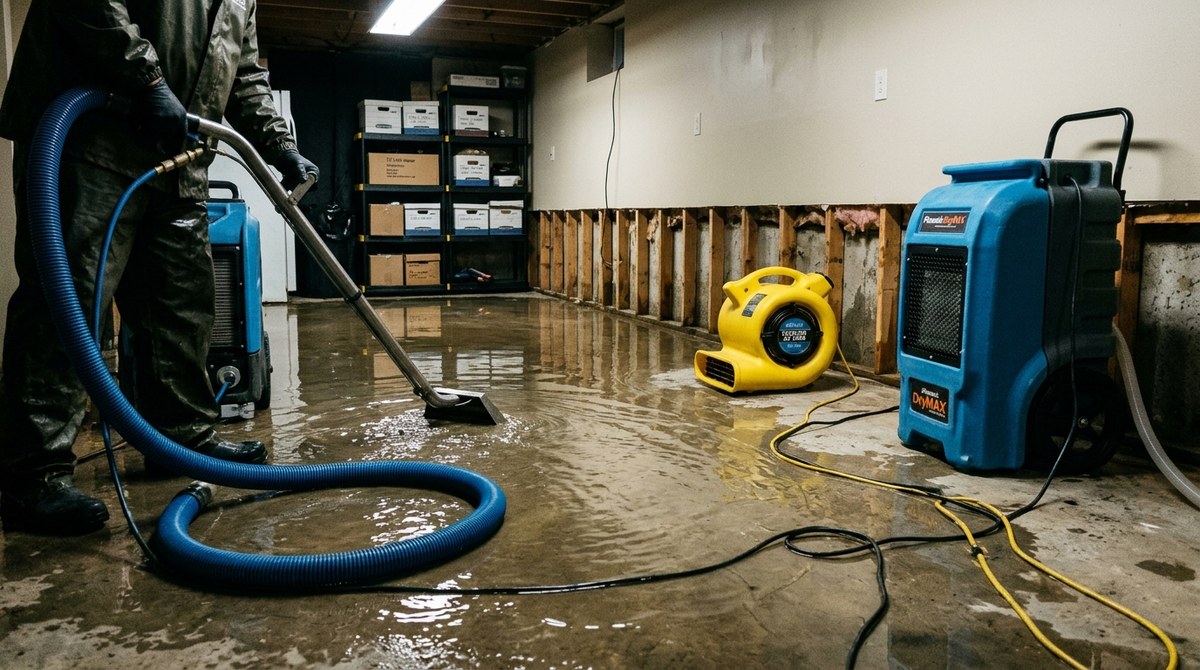
Stage 3: High-Capacity Bulk Extraction
Commercial vacuum lift removing thousands of gallons.

Stage 4: Sub-Surface Pad Extraction
Negative-pressure mats saving wood planks and carpet.
Why Mechanical Extraction Must Always Precede Drying
A core principle of restoration science states that physical extraction is hundreds of times more efficient than evaporative drying.
Energy & Time Conservation
It requires approximately 9,000 BTUs of thermal energy to evaporate a single gallon of water from structural wood. An industrial high-lift vacuum extractor removes that same gallon of liquid in less than two seconds.
Moisture Load Elimination
Thorough mechanical extraction removes up to 90% of the total water load from wet materials before drying fans are turned on, dramatically reducing the drying time required.
Preventing Secondary Condensation
Attempting to dry soaked materials with fans without thorough extraction drives relative humidity above 75%, forcing moisture into unflooded ceilings, doorframes, and attics.
What to Do While Waiting for the Extraction Truck
During the 45 to 90 minutes between your emergency call and our on-site arrival, take these immediate safety precautions:
Stop the Water Flow
Shut off your main water valve if the source is an internal plumbing break or burst appliance line.
Prioritize Electrical Safety
Never walk into standing water near electrical appliances or baseboards. Turn off circuit breakers only if your electrical panel is in a dry, accessible area.
Elevate Furniture
Place small squares of aluminum foil or plastic food wrap beneath wooden furniture legs resting on wet carpet to prevent stain transfer.
Avoid Using Home Shop Vacuums
Standard household shop vacuums lack safety grounding for large water volumes and pose electrical shock risks.
Photograph the Scene
Capture photos and video of water levels on walls and floors for your insurance claim records.
Need Immediate Professional Water Extraction?
Our emergency dispatch team is available 24/7/365 to mobilize extraction trucks to your home or facility. Call Water Extract Pro right now at +18556169295.